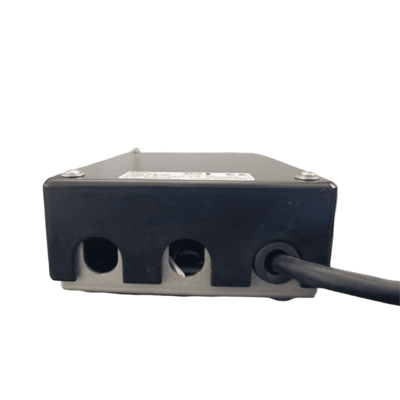
The SAILOR H2049 Connector Box by Thrane & Thrane (now part of Cobham SATCOM) is an interconnection unit designed to simplify the wiring and integration of various accessories and external equipment with a main SAILOR communication system, most commonly MF/HF radio systems or potentially Inmarsat-C terminals.
It acts as a centralized junction box that provides a neat and organized way to connect:
- External alarms: For distress, general alarm, etc.
- Line audio: For connecting external speakers or microphones.
- GPS input: For providing position data to the communication system.
- Additional handsets or control units: Extending the operational points of the main radio.
- Other auxiliary inputs/outputs: Depending on the specific communication system it supports.
Technical Specification
General Information:
- Manufacturer: Thrane & Thrane A/S (now Cobham SATCOM)
- Model: H2049 Connector Box (often identified with a part number like 80204901 or similar, possibly with suffixes like “2-MT” or “1-MT” indicating cable length or configuration)
- Purpose: Interface and connection point for external equipment (e.g., alarms, audio, GPS) to a main SAILOR communication system.
Electrical Specifications (Passive/Signal Routing):
- Power Requirements: The H2049 is typically a passive device, meaning it does not require its own power supply. It facilitates connections and signal routing, often taking power from the main communication unit it’s connected to for any powered accessories (like an external handset).
- Signal Types Handled:
- NMEA 0183 (RS-422/RS-232): For GPS input (position data).
- Audio (Line In/Out): For external speakers, microphones, or line audio interfaces.
- Alarm Signals (Contact Closures): For distress alarms, general alarms, or other status indications.
- Handset/Control Signals: Proprietary signals for connecting additional SAILOR handsets or remote control units, including microphone, earphone, PTT (Push-to-Talk), and supply voltage for the handset.
Physical Specifications:
- Enclosure: Typically robust, marine-grade plastic (e.g., ABS) or metal, designed for indoor mounting on a bulkhead or console.
- Dimensions: While exact dimensions for the H2049 are not readily available without a specific manual, similar SAILOR connection boxes are compact, often in the range of:
- Height: ~80-100 mm
- Width: ~100-150 mm
- Depth: ~30-50 mm
- Weight: Lightweight, likely less than 1 kg (2.2 lbs).
- Connectors:
- Typically a main multi-pin connector (e.g., 12-pin or 25-pin D-sub or proprietary) for the connection to the main SAILOR radio.
- Various smaller connectors (e.g., screw terminals, phono jacks, or dedicated multi-pin connectors) for external devices like:
- GPS input
- Alarm connections
- External speaker/microphone
- Additional handset
- Mounting: Designed for bulkhead or flush mounting.
Environmental Specifications:
- Operating Temperature: Likely designed for standard marine bridge environments: -15°C to +55°C.
- Storage Temperature: -25°C to +70°C.
- Humidity: Up to 95% non-condensing.
- IP Rating: Typically IP20 or IP22, indicating protection against vertically dripping water and solid objects, but not fully waterproof as it’s designed for indoor installation.
- Compliance: Expected to comply with general marine equipment standards like IEC 60945 for environmental performance, vibration, and EMC, as it’s part of a system that must meet these standards.
Key Internal Components (Simplified):
- Primarily terminal blocks, possibly some basic resistors or isolation components (e.g., opto-couplers for NMEA inputs) to ensure signal integrity and electrical protection between connected devices. It’s essentially a well-organized passive junction box.






There are no reviews yet.