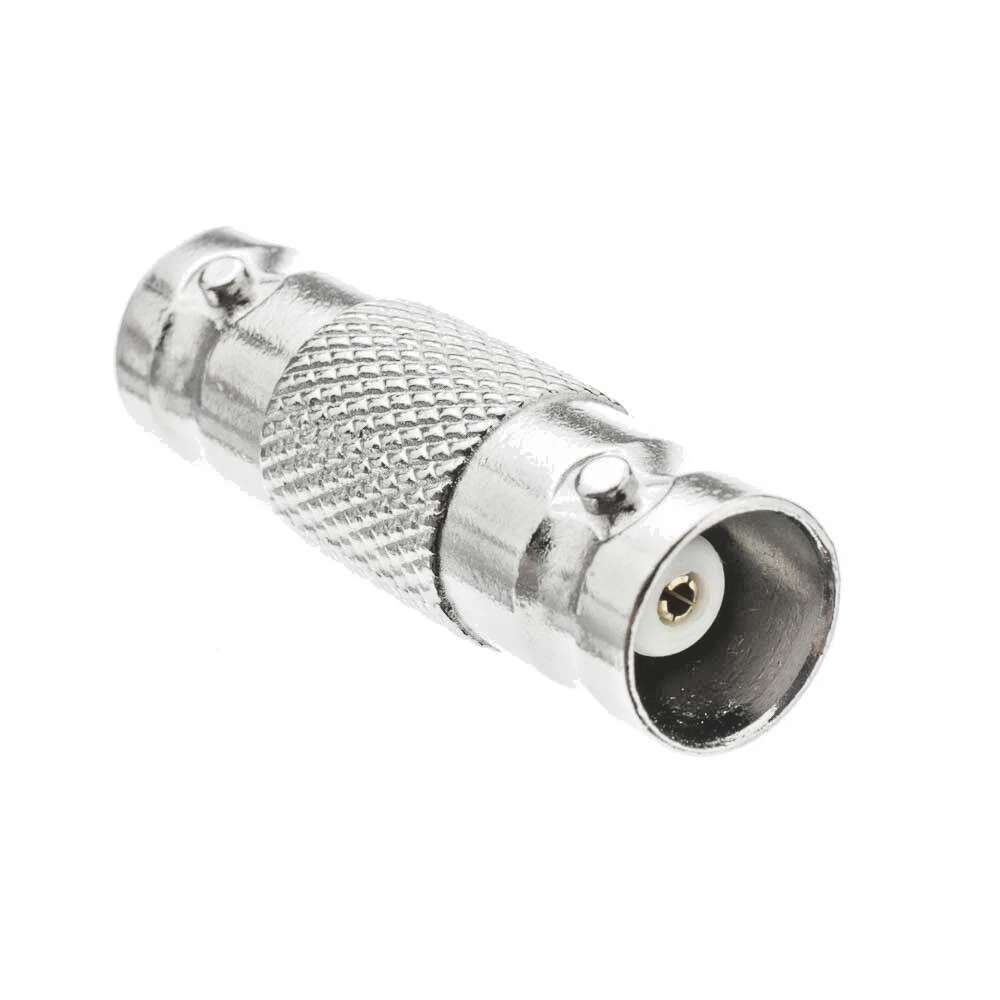
BNC Female to BNC Female adapter, often referred to as a BNC barrel connector or coupler, is a passive coaxial component designed to connect two BNC male connectors. It features a BNC female (jack) interface on both ends, allowing for the extension of cable runs or the interconnection of two devices that both have male BNC outputs. These adapters typically maintain the characteristic impedance of standard BNC connections, most commonly 50 Ohm or 75 Ohm, ensuring signal integrity across the connection. Constructed from durable materials like nickel-plated brass with PTFE insulation, they provide a reliable, low-loss electrical path and are widely used in video surveillance, broadcast, test and measurement, and various RF communication applications for their quick connect/disconnect bayonet coupling mechanism.
Technical Specification
1. Electrical Characteristics:
- Impedance:
- 50 Ohms (Ω): Most common for RF, test, and data applications.
- 75 Ohms (Ω): Common for video (SDI, HD-SDI, 3G-SDI, 6G-SDI, 12G-SDI) and some telecom applications.
- Note: 50 Ohm and 75 Ohm adapters are generally not intermateable without significant impedance mismatch. Ensure the adapter’s impedance matches the connected cables/devices.
- Frequency Range:
- 50 Ohm: DC to 4 GHz (standard), some precision versions up to 6 GHz or 11 GHz.
- 75 Ohm: DC to 3 GHz (standard for video), some high-performance/HDTV versions up to 6 GHz or 12 GHz (for 12G-SDI).
- VSWR (Voltage Standing Wave Ratio):
- 50 Ohm: Typically ≤1.20:1 up to 3 GHz; ≤1.30:1 up to 4 GHz.
- 75 Ohm: Typically ≤1.10:1 up to 3 GHz; ≤1.25:1 up to 6 GHz (for HDTV grade).
- Insertion Loss: Very Low.
- Typically ≤0.1 dB at 1 GHz.
- ≤0.2 dB at 3 GHz.
- ≤0.3 dB at 6 GHz (for high-frequency types).
- Return Loss: High.
- 50 Ohm: Typically ≥20 dB at 3 GHz.
- 75 Ohm: Typically ≥26 dB at 3 GHz (for HDTV grade); ≥18 dB at 12 GHz.
- Working Voltage: 500 V RMS (at sea level)
- Dielectric Withstanding Voltage: 1500 V RMS (at sea level)
- Insulation Resistance: ≥5000 M$\Omega$
- Contact Resistance:
- Center Contact: ≤1.5 m$\Omega$
- Outer Contact: ≤1.0 m$\Omega$
2. Mechanical Characteristics:
- Connector Type: BNC Female (Jack) to BNC Female (Jack)
- Mating Interface: BNC (per MIL-STD-348B/301 or IEC 61169-8) on both ends.
- Coupling Mechanism: Bayonet (quick connect/disconnect)
- Durability (Mating Cycles): ≥500 cycles (standard), ≥1000 cycles (for high-grade versions)
- Body Style: Straight Barrel (most common), some may have mounting flanges (bulkhead type).
3. Materials and Finishes:
- Body: Brass, Nickel Plated (typically 100 µin min for corrosion resistance)
- Center Contacts: Phosphor Bronze or Beryllium Copper, Gold Plated (typically 3-50 µin over Nickel for optimal conductivity and wear resistance)
- Insulators: PTFE (Polytetrafluoroethylene / Teflon) for excellent electrical properties and high temperature performance. Less expensive versions may use Delrin or PE.
4. Environmental Characteristics:
- Operating Temperature Range:
- PTFE Insulated: −65∘C to +165∘C
- PE/Delrin Insulated: −40∘C to +85∘C
- Thermal Shock: MIL-STD-202, Method 107, Condition B
- Vibration: MIL-STD-202, Method 204, Condition D
- Mechanical Shock: MIL-STD-202, Method 213, Condition I
- Moisture Resistance: MIL-STD-202, Method 106
- Corrosion (Salt Spray): MIL-STD-202, Method 101, Condition B (48 hours







There are no reviews yet.