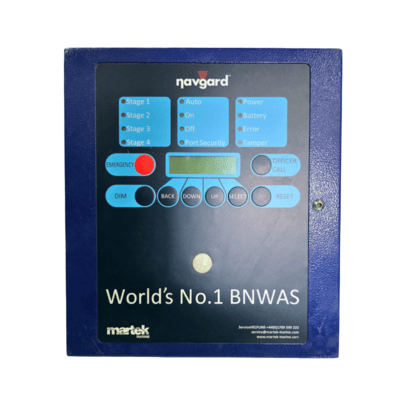
The Martek Marine Navgard BNWAS (Bridge Navigational Watch Alarm System) with part number T052060928 is a crucial maritime safety system designed to monitor bridge activity and detect periods of inactivity by the OOW (Officer of the Watch), which could indicate incapacitation and lead to marine accidents.
In brief, it’s a SOLAS-compliant alarm system that automatically triggers escalating alarms if the watch officer doesn’t acknowledge the system within pre-set intervals, eventually alerting backup officers to ensure continuous navigational watch and safety on board. It features a control panel, often with integrated motion detection, and can be expanded with additional reset units and motion sensors for comprehensive bridge coverage.
Technical Specification
Compliance & Approvals:
- SOLAS Compliance: Fully compliant with SOLAS Regulation V/19, as amended by MSC.282(86).
- Performance Standards: Meets the performance standards set out by IMO Resolution MSC.128(75) and IEC 62616:2010.
- Type Approvals: Approved by all major classification societies (e.g., ABS, Bureau Veritas, DNV, Lloyd’s Register, ClassNK, Russian Register, China Register, Indian Register of Shipping) and often by national authorities like the US Coast Guard (USCG).
- MED Approval: Typically holds Marine Equipment Directive (MED) approval.
Operational Modes:
- Standard Modes: ON, OFF, Automatic (auto-arming based on ship’s master/heading control), Port Security.
- System Test: Dedicated mode for system testing.
Alarm Stages & Timing (User Selectable):
- Stage 1 (Primary Alarm): Visual indication and audible alarm on the bridge (e.g., control panel, bridge wing units).
- Dormant Period: User selectable (e.g., 3-12 minutes in 1-second increments).
- Stage 2 (Secondary Alarm): Audible alarms in Master’s cabin and potentially Deck Officer’s cabins. Triggered if Stage 1 is not reset within a pre-set time (e.g., 15-90 seconds).
- Stage 3 (Tertiary Alarm): Audible alarms in public areas (e.g., Officer’s Mess, Saloon, Recreation room, Ship’s office). Triggered if Stage 2 is not reset within a pre-set time (e.g., 90-180 seconds).
- Stage 4 (Optional): Connection to the ship’s general alarm system.
Control Panel (Main Unit):
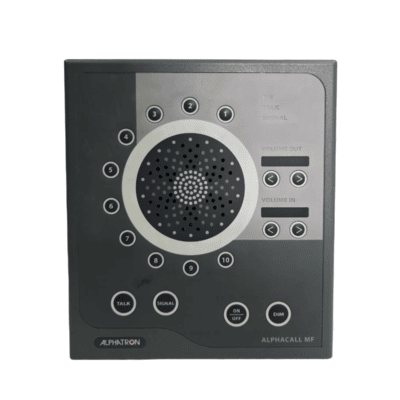
- Part Number: T052060928 refers to a specific model of the Navgard BNWAS, often the main control unit itself.
- Mounting: Can be bulkhead-mounted or console-mounted.
- Display: Typically a 2-line, 16-character alphanumeric back-lit LCD.
- Controls: Membrane keypad for: Reset, Officer Call, Emergency Call, and navigation keys (Up, Down, Select, Back).
- Internal Siren: High-intensity siren for bridge alarm (e.g., 85dB @ 1m, 1000Hz with selectable tone).
- Integrated Motion Detector: Built-in Passive Infra-Red (PIR) motion sensor with a typical range of 10 meters. Some models feature “Dual Tech” (PIR + Microwave) sensors to minimize false resets.
- Battery Back-up: Integral sealed Nickel Metal Hydride (NiMH) batteries providing quiescent backup power (e.g., ~6 hours). This eliminates the need for a separate emergency power cable.
- Fault Alarm: Built-in fault alarm output.
- Cabin Select Function: Integral function, removing the need for a separate selector switch.
Inputs & Outputs:
- Reset Inputs:
- Up to 8 Passive Infra-Red (PIR) motion sensors (e.g., illuminated directional PIR, 360° PIR).
- Up to 6 manual pushbuttons (illuminated).
- 1 On Board directional PIR (integrated into the control panel).
- Digital inputs (up to 4) from external systems for automatic reset (e.g., autopilot/gyro compass, radar/ARPA, navigation equipment power fail).
- Relay Outputs: Multiple SPCO NDE relays (e.g., 14 relays rated 1A @ 24V DC / 0.5A @ 110V AC) for connecting to external alarms (cabin alarms, general alarm, etc.).
- Serial Communications:
- 1 RS485 output to VDR via NMEA0183 (IEC 61162-1) for alarm logging.
- 1 Auxiliary RS485 programmable channel.
Data Logging:
- Internal SD Card: On-board data logging to a 2Gb SD card, recording thousands of alarm events in real-time with timestamps. This provides a permanent record of bridge activity.
- Password Protection: Password-protected switch-off function to prevent unauthorized deactivation.
Power Supply:
- Operating Voltage: Typically 24V DC.
- Redundant Power: Features a built-in power supply with redundant power capability (often from ship’s main and emergency DC sources).
Physical & Environmental:
- Enclosure: Rugged enamelled steel enclosure (e.g., wall mount 250W x 280H x 130D mm, IP54). Console/flush mount options available.
- Weight: Approximately 4 kg (main control panel).
- Cable Glands: M16 IP66 polyamide (supplied).
- Cable Type: Typically 4-core 0.5mm² (screened) marine cable.
- Operating Temperature: Designed for marine environments, compliant with IEC 60945 (e.g., -15°C to +55°C).
- Storage Temperature: Typically -25°C to +70°C.
- Humidity: Operating humidity ranges (e.g., up to 95% non-condensing).
- Vibration and Shock: Designed to withstand shipboard vibration and shock.
- EMC: Complies with relevant electromagnetic compatibility standards.
Modular Design:
- The system is highly modular, allowing for easy expansion with additional PIR sensors and manual reset units to suit any bridge size or layout, including weatherproof versions for bridge wings.

















There are no reviews yet.