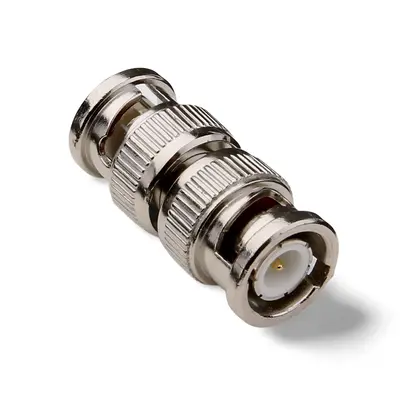
BNC Male to Male Adapter is a specialized coaxial connector designed to bridge two BNC female connections or to convert a BNC female connection to a BNC male one. Featuring a BNC male connector on each end, these adapters are commonly used in various radio frequency (RF), video, and networking applications, particularly with coaxial cables like RG-59 and RG-6. They are built with a secure, quick-connect/disconnect bayonet coupling mechanism that requires only a quarter-turn to establish a robust connection, ensuring reliable signal transmission with minimal loss. Available in both 50-ohm and 75-ohm impedance versions, they typically support frequencies up to 4 GHz and are made with durable materials like nickel-plated brass and gold-plated center pins for optimal performance and longevity.
Technical Specification
1. Impedance:
- 50 Ohm: Primarily used for RF and data communication applications, including radio antennas, test equipment, and networking (e.g., older Ethernet). These typically support higher frequencies.
- 75 Ohm: Primarily used for video applications, including composite video, SDI (Serial Digital Interface), CCTV systems, and broadcast equipment, matching the impedance of video coaxial cables (e.g., RG-59, RG-6). True 75-ohm connectors are designed to minimize signal reflections in video systems.
- Note: While 50-ohm and 75-ohm BNC connectors can physically mate without damage, electrical performance will be degraded, especially at higher frequencies, if impedance is mismatched.
2. Frequency Range:
- 50 Ohm: Typically operates from DC (direct current) up to 4 GHz. Some specialized or extended-range designs can go higher, up to 11 GHz or even 12 GHz.
- 75 Ohm: Generally operates from DC up to 1 GHz or 2 GHz, optimized for analog and digital video signals. High-definition (HD) video applications often require true 75-ohm connectors with excellent performance up to 6 GHz or 12 GHz for 12G-SDI.
3. Electrical Performance:
- Voltage Rating (Working Voltage): Typically 500 V RMS (Root Mean Square) maximum continuous.
- Dielectric Withstanding Voltage: Around 1500 V RMS (at sea level).
- VSWR (Voltage Standing Wave Ratio): A measure of signal reflection. Lower values indicate better impedance matching and less signal loss.
- For 50 Ohm: Typically 1.3:1 maximum up to 4 GHz.
- For 75 Ohm: Can be around 1.5:1 maximum up to 4 GHz, or as low as 1.05:1 + 0.1f(GHz) for high-performance true 75-ohm connectors.
- Insertion Loss: Measures signal power lost through the connector. Typically very low, often less than 0.2 dB at 3 GHz.
- RF Leakage: A measure of how much RF energy leaks out of the connector. Typically -55 dB minimum at 3 GHz.
- Insulation Resistance: Minimum 5000 Megohms.
- Contact Resistance:
- Center contact: Typically 1.5 milliohm maximum.
- Outer contact: Typically 1.0 milliohm maximum.
- Power Handling: Can vary, but typically around 316 W maximum at 1 GHz (at 25°C).
4. Mechanical Specifications:
- Mating Cycles (Durability): Designed for a minimum of 500 insertion/extraction cycles.
- Coupling Mechanism: Bayonet lock, requiring a quarter-turn for secure connection.
- Interface Specification: Compliant with MIL-STD-348A (for physical dimensions and mating interface).
- Dimensions: Defined by the MIL-STD-348B standard for both 50 Ohm and 75 Ohm versions.
5. Material Specifications:
- Body/Outer Shell: Typically made of brass, often with nickel plating for corrosion resistance and durability. Some may use zinc alloy or stainless steel.
- Center Contact (Pin): Usually made of brass or beryllium copper, with gold or silver plating for excellent conductivity and corrosion resistance (e.g., 30 µ-in minimum gold plating).
- Insulator/Dielectric: Commonly made of PTFE (Teflon) for high-frequency performance and temperature stability, or Delrin for lower cost and less demanding applications.
- Gasket: Often silicone rubber for environmental sealing.
6. Environmental Specifications:
- Operating Temperature Range: Typically -55°C to +165°C (with PTFE insulator) or -40°C to +85°C (with Delrin insulator).
- Moisture Resistance: Designed to withstand continuous moisture exposure (e.g., MIL-STD-202, Method 106).
- Corrosion Resistance: Often tested for salt spray resistance (e.g., 48 hours, MIL-STD-202, Method 101).
- Shock and Vibration: Designed to withstand mechanical shock (e.g., 50 G) and vibration (e.g., 20 G from 80-2000 Hz) per MIL-STD-202.













There are no reviews yet.